Technology of Hyperflow AI ①
The core challenge in developing generative AI applications lies in orchestration and operational architecture. HyperFlow is a no-code development platform that visualizes this complexity through flow graphs, enabling the structural design of generative AI systems.
Generative AI has become an essential technology rather than an optional one. From chatbots and search to customer support, document processing, content generation, and knowledge base construction, generative AI is already operating at the core of real-world business. Ironically, however, even as AI models continue to become more powerful, building AI applications has become increasingly difficult. In this article, we examine the root causes of this challenge, explore how HyperFlow AI redesigns this complexity at the level of technical architecture, and introduce the core technological concepts that form its foundation.
The Reality of Generative AI App Development: The Problem Is Not the “Model,” but the “Connections”
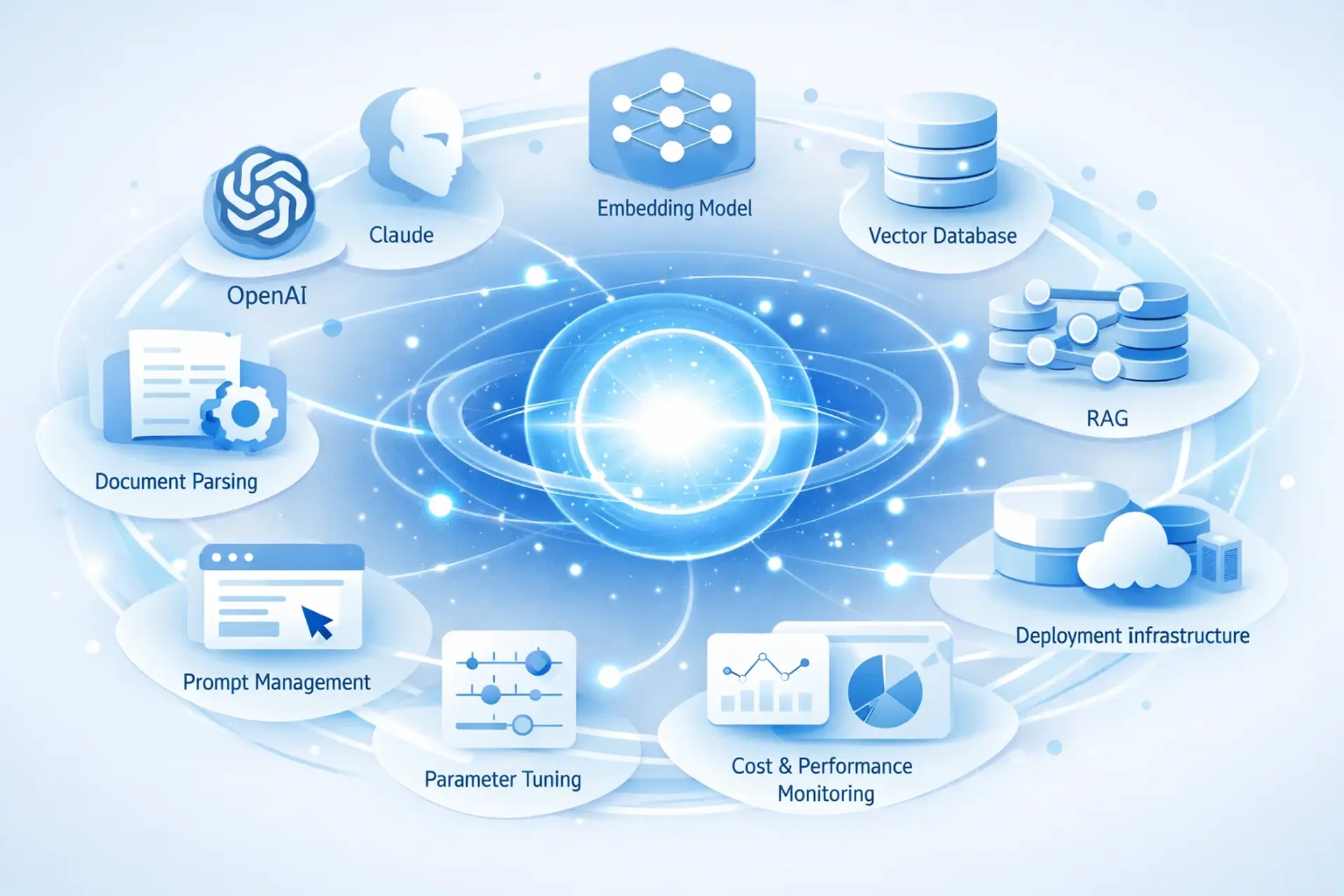
What does it actually take to build a robust generative AI application?
- LLMs (OpenAI, Claude, Gemini, etc.)
- Embedding models
- Vector databases
- Document parsing and segmentation
- RAG-based retrieval and re-ranking
- Prompt template management
- Parameter tuning
- Logging, cost, and performance tracking
- Stable deployment and operational environments
Only when all of these components are organically connected does a functional generative AI application emerge. The problem is that each of these elements operates on different services, interfaces, and constraints. As a result, developers are forced to write thousands of lines of boilerplate code, modify entire pipelines just to replace a single service, and tolerate instability caused by differences between development and production environments.
In other words, the fundamental challenge of generative AI application development lies not in the performance of AI models, but in AI orchestration.
Limitations of Existing Workflow Tools
Workflow tools such as n8n and Zapier certainly exist. However, they have clear structural limitations when applied directly to generative AI development. Their nodes are tightly coupled to specific services, making replacements difficult, and their data flows are statically fixed. In addition, parameters cannot be flexibly adjusted during execution, and they are weak in handling repetition, loops, and history management. This means that these tools were not designed with the inherently iterative experimentation and optimization processes of AI development in mind.
The Starting Point of HyperFlow AI
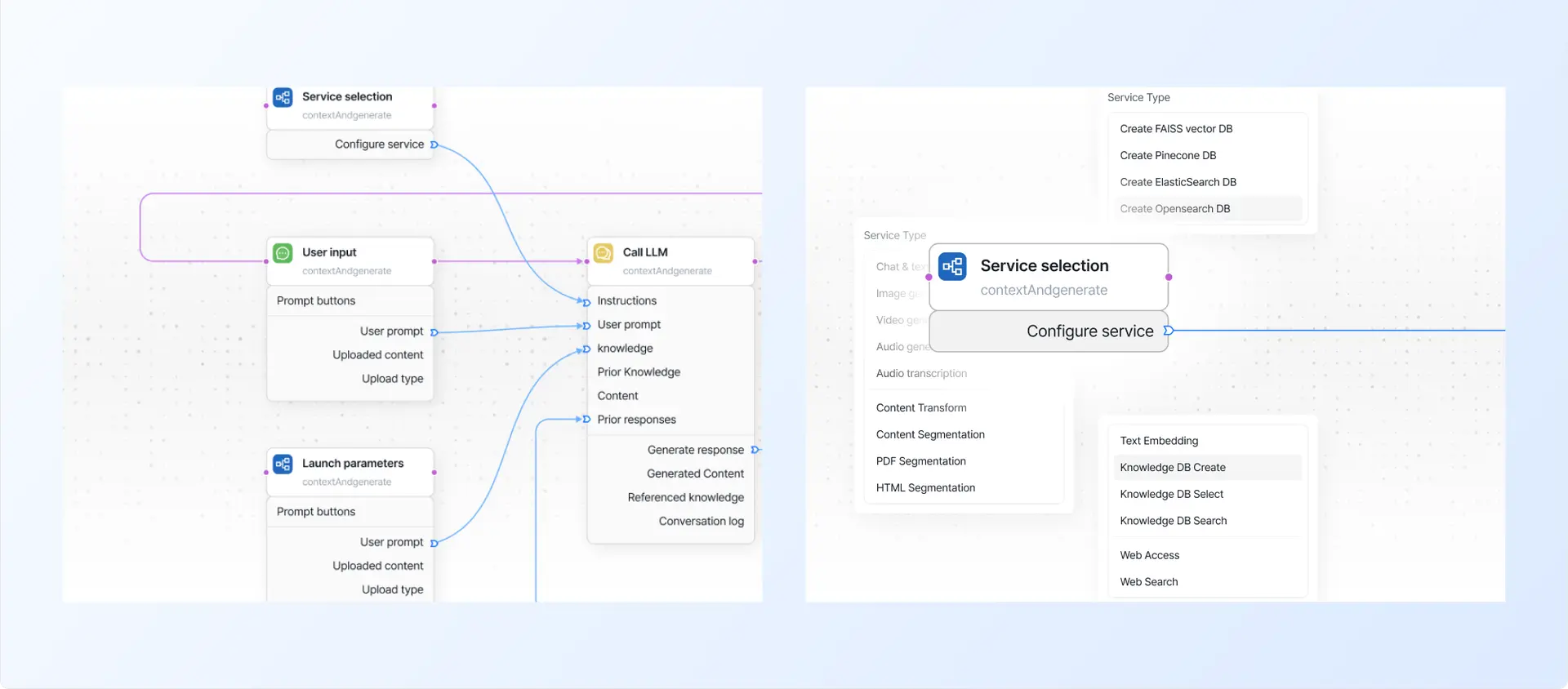
HyperFlow defines generative AI applications not as a single program, but as an “executable flow.” The fundamental building block of this flow is not text-based code, but a visually connected flow graph. HyperFlow’s flow graph is designed so that process flow, data flow, and parameter flow operate simultaneously within a single unified graph. Thanks to this architecture, the following tasks can all be naturally connected on the same execution model.
- RAG pipelines
- Multi-LLM collaboration
- Agent-based workflows
- Iterative experimentation and A/B testing
- Seamless transition from development to deployment
An Architecture Where Development and Deployment Are Not Split
Many AI systems work well during development but become unstable after deployment due to issues with parameters, environments, and state management. HyperFlow addresses this structurally by separating the development execution engine from the production execution engine, while ensuring that the exact same flow graph is executed in both environments. In other words, the flow graph that is experimented with and validated during development becomes the production application directly, without any additional transformation.
The Core of Technology Is “Sustainability”
The real problem HyperFlow aims to solve is not merely convenience or productivity improvement. AI models and services are constantly being replaced, and their pricing, performance, and policies change rapidly. In such an environment, if the core logic of an application is shaken along with these changes, the system cannot be maintained in the long run. That is why HyperFlow has chosen architectural abstraction that is not dependent on any specific model, vendor, or technology stack. As a result, in HyperFlow, workflows are no longer one-off implementations, but become technology assets (IP) whose value persists over time. HyperFlow goes beyond being a no-code development tool. It represents a technological approach for designing generative AI applications with scalability and long-term operation in mind from the ground up. In this series, we will take an in-depth look at the following core technologies that make up HyperFlow.
- The flow graph architecture of HyperFlow
- A service-agnostic Super Node architecture
- Treating parameters as “flows” rather than code
- An execution model that does not separate development and production
Through this structure, HyperFlow AI defines an execution model that enables generative AI to move beyond the experimentation phase and into real-world service operation.